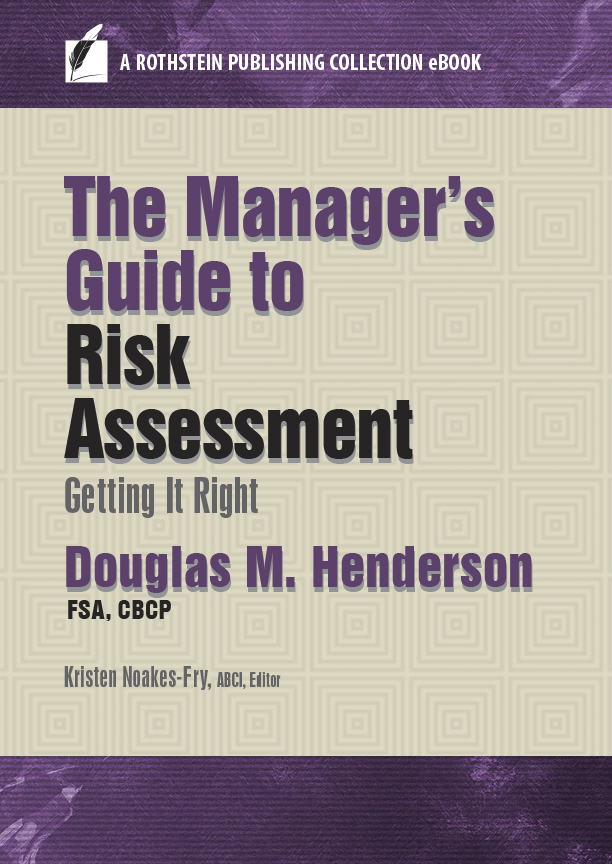
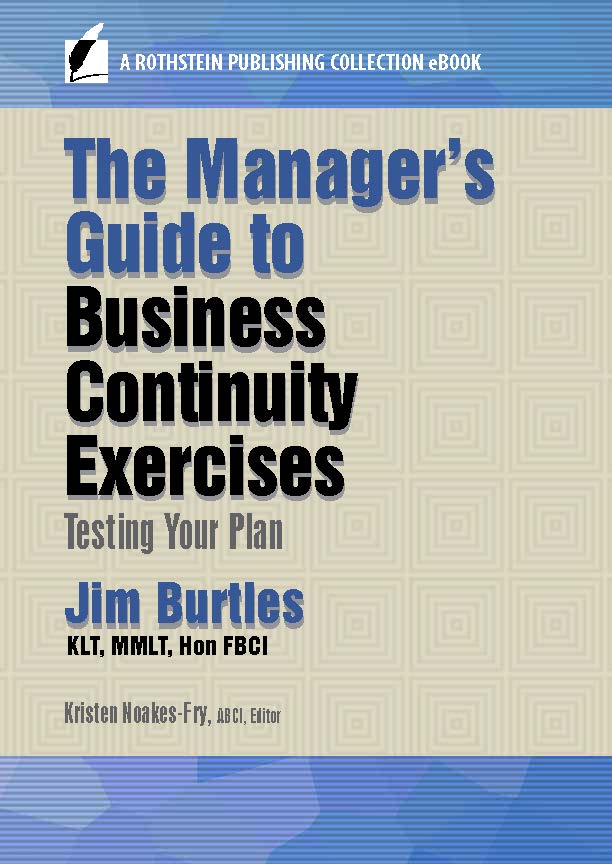
NEW RELEASES AND SPECIAL OFFERS!
School Crisis Continuity Template K-12
| ![[Item Image]](it010004.jpg) |
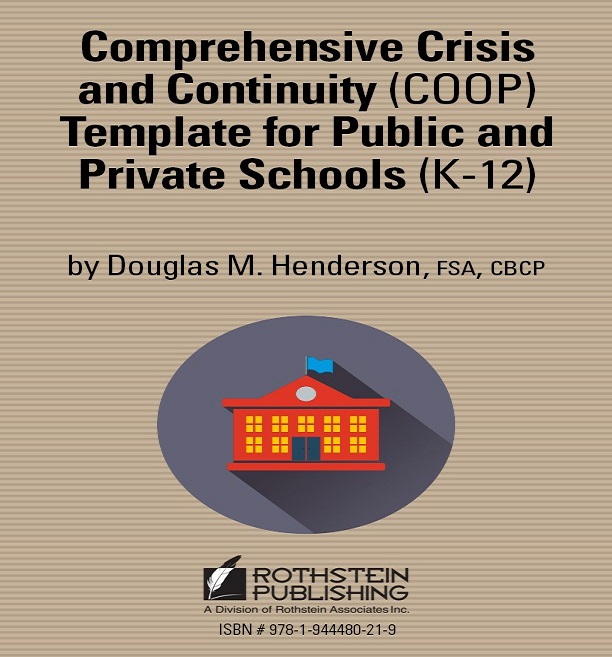
Comprehensive Crisis and Continuity (COOP)
Template for Public & Private Schools (K-12)
on CD-ROM, by Douglas M. Henderson.
2008, 650+ pages
|
|
|
|
DR828
|
|
$299.00
|
THE COMPREHENSIVE CRISIS AND CONTINUITY (COOP) TEMPLATE FOR PUBLIC &
PRIVATE SCHOOLS (K12) ON CD-ROM
Risk and Impact Analysis, Continuity of Operations Plan (COOP), Department/Division Plans
and Crisis/Risk Management Plan
By Douglas M. Henderson, FSA, CBCP
The COMPREHENSIVE CRISIS & CONTINUITY TEMPLATE is a complete template program
for public and private schools (K-12) on CD-ROM that includes advice for all development
steps from the Information Collection Process, through the Risk Analysis, to the actual Crisis
Response documentation, operational recovery and finally with assistance for the ongoing
exercising and maintenance process. It is scalable and appropriate for any size school.
- - - - - - -
Also available: a version designed for Colleges & Universities. See DR820 or contact
info@rothstein.com for details.
= = = = = = =
PLANNING FOR CRISES CAN BE OVERWHELMING - BUT WE'VE MADE IT EASY FOR
YOU!
- How can we protect our students?
- How do we assist our faculty and staff?
- How do we respond to an emergency?
- What are the priorities?
- What actions do we take first?
- How do we get started?
- Where do we begin?
- How do we collect data?
- What analysis do we need to perform?
The Comprehensive Crisis & Continuity Program identifies Step by Step solutions to these
and other important questions. The planning templates contain a considerable amount of
standard language that enables the user to easily review and edit text.
All files use Fill-In-The-Blank format and Microsoft Word Templates that are EASY TO
UPDATE and require NO SPECIAL TRAINING!
The COMPREHENSIVE CRISIS & CONTINUITY TEMPLATE follows professional standards
as recommended by the Disaster Recovery Institute International (DRII), Business Continuity
Institute Good Practices Guide (BCI) , National Fire Protection Association (NFPA) 1600
Standard on Disaster/Emergency Management and Business Continuity Programs as well as
industry best practices.
= = = = = = =
WHAT FILES ARE INCLUDED WITH THE TEMPLATES?
In addition to the ReadMe.doc file and a Bonus.doc file, the entire package is organized into
the following four major components:
- RISK AND IMPACT ANALYSIS - Information collection and analysis
- CONTINUITY OF OPERATIONS PLAN (COOP) - The central or overarching plan for
the school
- DEPARTMENT/DIVISION PLANS - A set of Emergency Operations Plans for the
various departments, operational groups and other infrastructural entities that comprise the
school
- CRISIS/RISK MANAGEMENT PLAN - Emergency response guidelines for school
leaders, faculty, staff and students
- ReadMe.doc - Introduction, user & copyright information
RISK AND IMPACT ANALYSIS FILES
- InformationCollectionChecklists.doc - Forms for gathering information about the school &
physical environment
- DepartmentDivisionQuestionnaire.doc - Forms to gather information about the activities of
the operational groups and support departments within the school
- K12.RIA.doc - The Risk and Impact Analysis template that is designed to become the
actual RIA for your school
- K12.RIA.sample.doc - A sample completed RIA for a hypothetical school
CONTINUITY OF OPERATIONS PLAN (COOP) FILES
- K12.COOP.doc - The Continuity of Operations Plan (COOP) template that is designed to
become the actual COOP for your school, including a central version for the school system
and parallel versions for each individual school/campus
- DepartmentDivisionResponsibilities.doc - The identification and assignment of
responsibilities to the department/divisions
DEPARTMENT/DIVISION (EMERGENCY OPERATIONS PLAN) FILES
- DepartmentDivisionResponsibilities.doc - The identification and assignment of
responsibilities to- the department/divisions
- DepartmentDivision.EOP.doc - An Emergency Operations Plan for the departments and
divisions of the school
- DepartmentDivision.EOP.Update.Instructions.doc - Instructions on updating the Emergency
Operations Plans
- AcademicAffairs.EOP.doc - An Emergency Operations Plan to maintain or rapidly restore
important education activities
- AuxiliaryServices.EOC.doc - An Emergency Operations Plan to maintain critical physical
support services
- BusinessServices.EOC.doc - An Emergency Operations Plan to maintain ongoing business
support services
- EnvironmentalHealthSafety.EOC.doc - An Emergency Operations Plan to maintain critical
environmental controls
- FacilitiesPlan.EOP.doc - Special building protection and recovery planning for the Facilities
Department
- FinanceAdministration.EOP.doc - An Emergency Operations Plan to maintain critical
financial support for the Finance & Accounting Department
- HumanResourcesPlan.doc - An Emergency Operations Plan to maintain critical employee
support services for the Human Resources Department
- InformationTechnology.DRP.doc - An comprehensive Disaster Recovery Plan outline of
critical technology support services for the IT Department
- PublicRelations.EOP.doc - An Emergency Operations Plan to maintain communications
with employees, students, news media and other interested parties
- ResidentialLife.EOC.doc - An Emergency Operations Plan to maintain housing services,
and emergency shelters
- Security.EOP.doc - An Emergency Operations Plan to maintain security before, during and
after a disaster
- StudentAffairs.EOC.doc - An Emergency Operations Plan to maintain critical student
support services
CRISIS/RISK MANAGEMENT PLAN FILES
- CRMP.K12.doc - The Crisis/Risk Management Planning template that is designed to
become the actual CRMP for your school
- HurricaneFloodPlan.doc - A special hurricane and flood plan supplement for colleges and
universities that face a serious hurricane or flood threat
- PandemicPlan.doc - A special plan designed to respond to a pandemic outbreak
- EmergencyResponsePlanFaculty&Staff.doc - An Emergency Response Plan for distribution
to faculty and staff
- EmergencyResponsePlanStudents.doc - An Emergency Response Plan for distribution to
students
- OnePageSummary.doc - A single page summary of emergency response guidelines for
posting in classrooms
- FamlyDisasterPlanning.doc - Important personal information summarized from the American
Red Cross
BONUS MATERIALS
- BonusFiles.doc - Articles of educational value
In summary, 29 files, over 650 pages plus Bonus Files!
= = = = = = =
HOW DO WE DEVELOP A COMPLETE PROGRAM?
EXECUTIVE COMMITMENT
Before any project can commence and have a reasonable chance of success, a commitment
must be secured from the highest levels of the organization. A 'Management Committee' (or
'Steering Committee') with significant senior management-level participation needs to be
assembled. Within the Management Committee an executive-level individual needs to be
placed in charge of the entire project. A management-level individual needs to be designated
as the 'Project Manager' to develop the actual documentation. Sufficient authority and
resources will have to be allocated to the entire project for it to be successful.
PROJECTS
In order to develop and maintain a comprehensive Crisis and Continuity Program, Disaster
Management, Inc. suggests a multi-project approach that parallels industry best practices as
follows:
Project 1 - After a commitment from management has been made; this first step involves the
Collection of Information needed to complete the necessary projects.
Project 2 - The development of a Risk and Impact Analysis (RIA)*. The RIA will include an
assessment of the natural and man-made risks that face the school. The RIA will also
analyze the recovery priorities and set objectives for the COOP and the need for other support
plans.
Project 3 - The development of a central or overarching plan or Continuity of Operations Plan
(COOP)* for the school.
Project 4 - The development of a Crisis/Risk Management Plan is needed to define
emergency actions to respond to actual specific emergency situations.
Project 5 - The development or update of the Information Technology Plan needed to maintain
the systems and communication capabilities of the school.
Project 6 - The development or update of the plans in place for the operational groups and
support departments or the Department/Division Plans needed to maintain critical operational
activities.
Project 7 - Involves the Implementation of the entire program.
Project 8 - Involves the Exercising, Training and Ongoing Requirements of the entire program.
* The "Risk and Impact Analysis" is the counterpart of the "Business Impact
Analysis" for a non-corporate entity. The Continuity of Operations Plan is the counterpart of
the "Business Continuity Plan" for a non-corporate entity.
- - - - - - -
Project 1 - Collection of Information

In order to assemble the information necessary to complete the planning process, the
following action steps should be taken:
1. Develop and confirm the details and projected timetable for the entire project.
2. Conduct a site inspection and gather information about the overall school.
- Identify risks & exposures
- Review safety & security issues
- Identify the level of planning in the technology area
3. Meet with representatives from each major 'department/division' (the support
departments, operational groups and other defined entities that comprise the school) and
assess the current level of planning.
Project 2 - Risk and Impact Analysis (RIA)
It is important to note that the Risk and Impact Analysis (RIA) is not a planning component;
rather the RIA establishes the guidelines (or 'road map') for the development of the COOP and
related plans. The RIA is a report subject to executive management review and approval.
An important component of the RIA is an evaluation of the natural and manmade risks that
threaten the organization. This is referred to as a Risk and Vulnerability Analysis, and this
analysis is included as part of the RIA.
All critical areas of the school that must remain operational or rapidly recover for normal
activities to continue need to be identified. It is widely acknowledged that it is not practical
for most organizations to rapidly restore all normal operations following a disaster. Therefore,
a key component of the RIA is to establish and prioritize critical operations. For each critical
operation, a Recovery Time Objective (RTO) is established.
Once critical operations and interdependencies are identified, strategies can be developed to
ensure ongoing function or rapid restoration. The RIA develops strategic solutions to respond
to potential disasters. Solution strategies focus on the maintenance and restoration of
critical services and do not necessarily attempt to replicate existing procedures.
The RIA also reviews the level of existing planning both in the Information Technology
department and throughout the other department/divisions. Recommendations regarding
additional planning or improvements to existing procedures are identified.
Project 3 - Continuity of Operations Plan (COOP)
The Continuity of Operations Plan (COOP) will develop the details of the response to a
disaster situation by the school. This is the overarching plan for the school and defines the
overall actions of the organization during an emergency. The central focus of a good COOP
is to identify and develop solutions to maintain or rapidly restore critical operations. Other
objectives of the COOP are to prevent man-made disasters, minimize the disruption of school
operations, mitigate damages, minimize legal exposures, comply with best practices and
assure the safety of faculty, staff, students and other individuals.
The Continuity of Operations Plan (COOP) is intended to establish policies, procedures and
organizational structure for response to emergencies that are of sufficient magnitude to cause
a significant disruption of the functioning of all or portions of the school. The COOP is the
official plan of the school and describes the roles and responsibilities of support departments,
operational groups and personnel during emergency situations.
Project 4 - Crisis/Risk Management Plan
Crisis response planning addresses the action steps to be taken to respond to specific
disaster events. The central focus of crisis response planning is first life safety and second
asset protection.
Planning should address all specific disasters of significance as identified in the RIA.
Planning includes steps to prepare for foreseen events (generally weather-related events),
actions to be taken during the event (almost entirely life-safety steps) and recovery after the
event. Recovery planning includes a time-phase process after a major disaster where there is
significant damage and where the general environment also will likely be dangerous.
Project 5 - Information Technology Plans
The Information Technology Plan ('Disaster Recovery Plan') includes the need for planning in
the following areas:
- Project 5A - Critical Data Management. This is a formal plan to secure, classify and
retrieve electronic information and critical applications.
- Project 5B - Data Center Recovery. This is a formal plan to reconstruct systems &
communication centers.
- Project 5C - Alternate Site Plan. Management determines the type of Alternate Site
Plan that is needed based on the established recovery time objectives, levels of service
degradation and the response that is cost justified.
- Project 5D - Information Security Plan. The need for additional Information Security
Planning is based upon management's objectives, audit requirements, costs, and the
effectiveness of existing controls.
Project 6 - Department/Division Plans
The operational effectiveness of the entire Crisis and Continuity Program will be dependent on
the proper actions being taken by all departments/divisions (the support departments,
operational groups and other defined infrastructural entities that comprise the school). The
Crisis and Continuity Program will define the goals and objectives of each
department/division. Twelve templates for department/division plans are provided for critical
support departments.
Project 7 - Implementation
Implementation includes the dissemination of information to the management team and to all
faculty, staff and students. Implementation also includes the actual assembly of all
materials, contracts, subcontractors, etc. (as specified in the plan) necessary to be in place
and ready in an emergency situation.
Project 8 - Exercising, Training and Ongoing Requirements
Although the entire Crisis and Continuity Program is completed, it is never finalized. Periodic
testing (or 'exercising'), training and updates are required to maintain the effectiveness of the
plan. Meeting of the key teams should take place several times a year. The documentation
defines maintenance and update procedures.
= = = = = = =
ABOUT THE AUTHOR
Douglas M. Henderson, FSA, CBCP, President of Disaster Management, Inc., has 20 years
of experience in management with major consulting firms. In August of 1992, Doug was the
key associate of the Emergency Response Team for a consulting firm located in South
Miami-Dade County. Inspired by real-life business experience with Hurricane Andrew and
concerned about the lack of preparation within the business and academic communities,
Doug founded Disaster Management, Inc. in 1993.
Doug has a Bachelor of Science Degree in Mathematics from the University of Arizona. His
professional credentials include FSA - Fellow, Society of Actuaries and CBCP - Certified
Business Continuity Professional. Doug is also a member of FEPA (Florida Emergency
Preparedness Association), the editor of DisasterALERT!, a member of the Miami-Dade
Terrorist Mitigation Committee, the author of the book Is Your Business Ready for the Next
Disaster? and numerous planning templates for schools, colleges & universities, businesses
and manufacturing published by Rothstein Associates Inc.
= = = = = = =
LICENSING:
Purchase of this product entitles the purchaser to edit and customize the contents to
produce ONE Risk and Impact Analysis Template, ONE Continuity of Operations Plan
(COOP) Plan Template, ONE Department/ Division Plan Template for each
Department/Division and ONE Crisis/Risk Management Plan Template for a single school
entity at a single location.
Contact the Publisher at info@rothstein.com for licensing options for additional locations.
Quantity, enterprise and developers' licensing options and discounts are available.
= = = = = = =
2008, CD-ROM, 650+ pages. Order #DR828
ISBN #1-931332-47-9
= = = = = = =
Rothstein Associates Inc.
4 Arapaho Rd.
Brookfield, CT 06804-3104 USA
1-888-ROTHSTEin; (888.768.4783)
Telephone: 203.740.7444; 888.768.4783
Fax: 203.740.7401