
How the future of issue and crisis management is being redefined
by Tony Jaques, Director of Issue Outcomes Pty Ltd, for people who work in issue and crisis management
A new report from SenateSHJ, based on interviews with experts worldwide, predicts that by 2030, crisis recovery will no longer be about image repair – it will be about institutional renewal.
It says crisis management will move from a reactive function to a continuous discipline with systems that detect reputational stress in real time, powered by behavioral data, predictive analytics, and ethical governance.
Moreover, that reputation strength will be defined not by whether companies avoid crises but by how they prepare and how quickly and effectively they learn from them.
Beyond this reputation focus, I see three specific crisis trends going forward which will undoubtedly impact the way issue and crisis managers work.
The first of these is an increasing focus on punishment for CEOs and other top executives for personal bad behavior, where pundits and boards are quick to condemn.
Just within the last few months, the global CEO of Nestle was ousted for concealing a relationship with a subordinate, and insurance giant IAG withdrew a $17 million job offer to a top executive at the last minute after it discovered his last employer had investigated an alleged workplace affair with a younger staffer. And who can forget the married CEO of Astronomer forced out after being caught cuddling one of his staff on kiss-cam at a Coldplay concert!
Another trend involving CEOs is the increasing expectation that “heads will roll” in the aftermath of an organizational crisis. There is no clearer example than when Boeing CEO Dennis Muilenburg was sacked in 2019 to “restore confidence in the company” after two fatal aircraft crashes.
Or, when the CEO of Westpac resigned, and his Chairman agreed to step down following a money-laundering scandal engulfing the bank. Or when the CEO of Optus had no choice but to resign after the 2023 nationwide outage that took down their phone and internet services. Or, more recently, when the Director General and chief of news at the BBC suddenly departed over supposedly misleading edits in a TV documentary about Donald Trump.
While calls for heads to roll after a crisis are typical online fodder, they are increasingly common, and it gets more serious when politicians get into the act. After the Optus triple-zero outage in September 2025, one headline read “PM suggests heads may roll at Optus after outage.” However, Prime Minister Albanese has not publicly repeated this suggestion, and the new CEO has so far survived.
My third major trend, which can only get stronger, is product crises leading to mammoth lawsuits and breathtaking penalties and settlements (even if payments often get tied up in endless appeals). For example, last October, a bankruptcy judge in the US cleared a deal that forces Purdue Pharma and its billionaire owners to pay out $US7.4bn over their role in the US opioid crisis.
In that same month, a jury in Los Angeles ordered Johnson and Johnson to pay $US966 million to the family of a woman who died from mesothelioma, the largest figure ever awarded in such a case against the company in their ongoing crisis about asbestos in their baby powder allegedly causing cancer. This comes after the company previously attempted in 2023 to settle 60,000 claimants with a proposed settlement of a staggering $US8.9 billion ($AUD13.1 billion). Their long-running crisis continues to face class actions involving tens of thousands of claimants around the world.
While most issue and crisis managers will never be involved in such massive cases, the important lesson now, and for the future, is that claimant expectations everywhere continue to escalate. As a result, some product crises are no longer just reputational problems but can be existential threats to the organization.
As the SenateSHJ report commented: “By 2030 Leadership will no longer be judged by a crisis response or quarterly results but by the cultural footprint they leave behind.”
A Parting Thought
Prediction is very difficult, especially about the future.
Niels Bohr
Learn more about Reputation Risk, CEO apologies, and Crisis communication in Tony Jaques’ book,
Crisis Counsel: Navigating Legal and Communication Conflict
Click HERE to find Tony’s book at Amazon.com
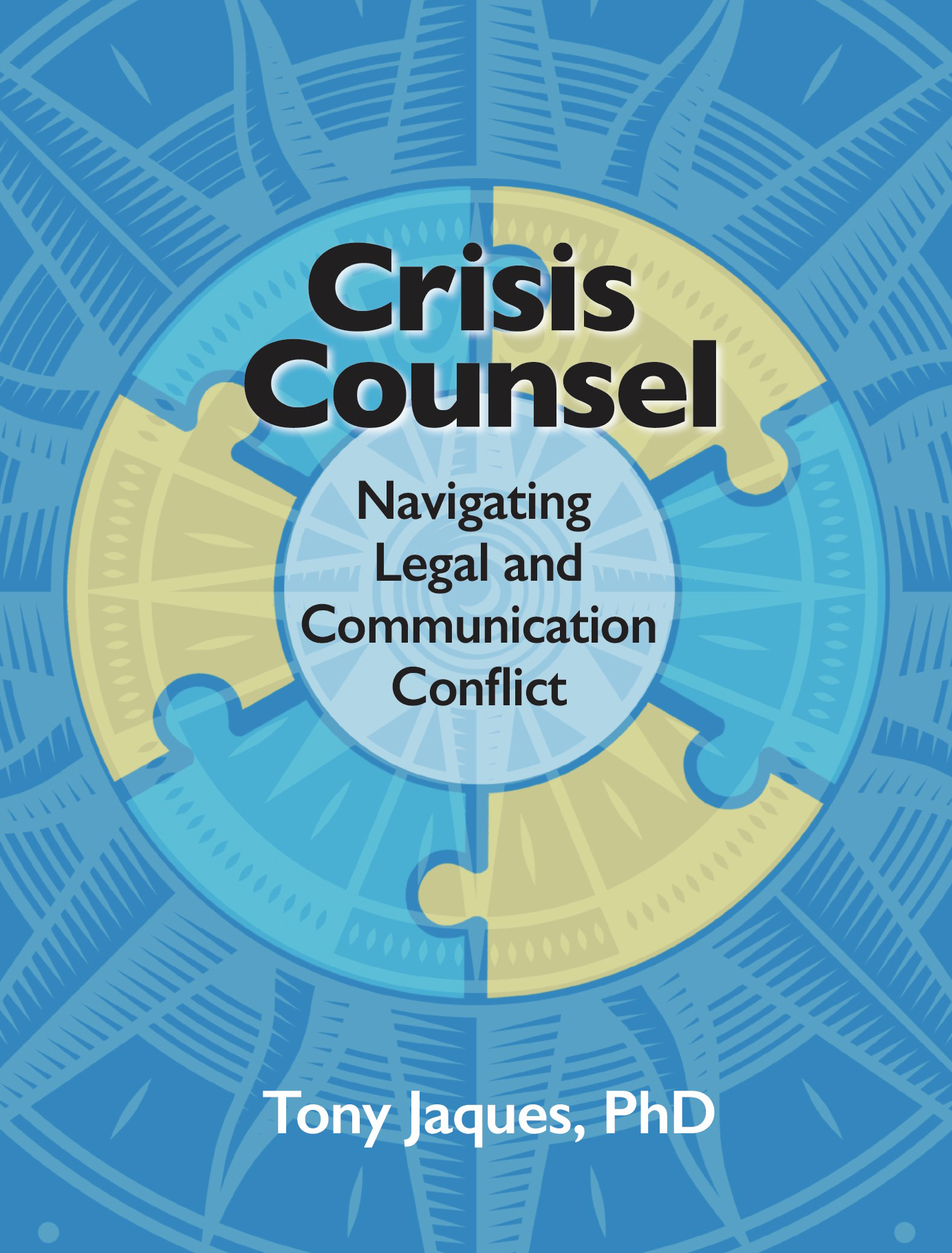
“Crisis Counsel confirms Tony Jacques’ position as one of the industry’s foremost experts on issues and crisis management. In addressing the complex interactions between legal and communication crisis responses, Dr. Jacques provides riveting case studies and practical advice. It highlights the financial and reputation risks of not effectively integrating communications and legal counsel. It should be on every communications practitioner’s reading list, and companies should insist their in-house and external legal counsellors read it.” – Noel Turnbull, Former Chair of Turnbull Porter Novelli, Adjunct Professor, RMIT University.
#reputationrisk #reputationmanagement #issuemanagement #tonyjaques
